
What is Eurodance?
⭐ 1. What is Eurodance?
Eurodance is a European electronic dance music genre that emerged in the late 1980s and became hugely popular in the 1990s. It blends techno, house, Hi‑NRG, trance, and Euro‑disco, featuring strong synth melodies, energetic beats, and a signature mix of female vocal hooks and male rap verses.
Eurodance continues to inspire new artists today, with dedicated revival projects such as 7Dance producing authentic new music in 2025–2026.
⭐ 2. When did Eurodance start?
Eurodance originated in the late 1980s (roughly 1987–1989) in central Europe, with the strongest roots in Germany, Belgium, and the Netherlands. It emerged from the exploding rave and club scenes of that era, blending influences from Chicago house, Belgian new beat, Hi-NRG, Eurodisco, early techno, and hip-hop rap elements.
⭐ 3. When was Eurodance most popular?
Eurodance reached its absolute peak popularity during the mid-1990s (roughly 1992–1997), when it dominated European charts, radio airplay, MTV Europe, club scenes, and even crossed over significantly into the US, Australia, and parts of Asia. This era is widely regarded as the golden age of Eurodance, with the genre producing some of the most iconic dance anthems of all time.
⭐ 4. When did Eurodance end?
The golden era is often considered to span 1993–1998, from Corona's The Rhythm of the Night to Eiffel 65's Blue (Da Ba Dee). After 1998, the genre gradually faded from mainstream charts as trance, garage, and R&B took over European radio.
Source: Linkiesta – Le migliori canzoni Eurodance
⭐ 5. What are the characteristics of Eurodance?
- Fast BPM, typically between 135 and 145
- Catchy, euphoric synthesizer hooks
- Female lead vocals on the chorus
- Male rap verses in the verses
- Positive, uplifting lyrics — themes of love, freedom and dancing
- Dancefloor-focused production with four-on-the-floor kick drum
⭐ 6. Who are the most famous Eurodance artists?
Some of the most iconic acts include:
- 2 Unlimited
- Culture Beat
- Corona
- Snap!
- La Bouche
- E-Type
- Fun Factory
- DJ Bobo
- Haddaway
- Eiffel 65
Full discographies and biographies are available at the Eurodance Encyclopaedia (Eurokdj).
⭐ 7. Is Eurodance EDM?
Yes, Eurodance is EDM, but with its own strong and distinct identity.
- Core EDM traits: fully electronic production, made for the dancefloor, influenced by house, techno and disco.
- Distinct Eurodance features:
- Euphoric female lead vocals combined with male rap verses — a formula defined by acts like Haddaway, La Bouche, 2 Unlimited and Corona.
- Extremely catchy, pop-friendly hooks designed for both radio and the dancefloor.
- Uplifting, feel-good energy — more accessible and commercial than pure techno or house.
- Strong pop adjacency compared to darker or more underground EDM styles.
⭐ 8. Is Eurodance still alive today?
Yes — although no longer mainstream, Eurodance remains active through:
- Nostalgia playlists on Spotify, Apple Music and YouTube
- Modern EDM producers drawing on 90s influences
- Live tours and festival appearances by classic acts
- New dedicated revival projects such as 7dance, producing authentic 100% AI-free Eurodance in 2025 and 2026
⭐ 9. Where can I find Eurodance information today?
The most complete resource is the Eurodance Encyclopaedia (Eurokdj), which includes news, biographies, complete discographies, lyrics and audio samples — continuously updated since 1999.
⭐ 10. Why is Eurodance so nostalgic?
Because it was everywhere in the 1990s — clubs, radio, TV countdowns, shopping malls — and its upbeat, melodic style created a shared cultural soundtrack across an entire continent. For a generation, Eurodance is the sound of summer, youth and freedom.
⭐ 11. What is the difference between eurodance and eurobeat?
Eurodance and Eurobeat are often confused because of the similar name, but they are two distinct genres with different origins, sounds, and audiences.
Eurodance emerged in central Europe in the late 1980s and is defined by its combination of female vocal hooks and male rap verses, euphoric synthesizer melodies, and a tempo of 135–145 BPM. It was a mainstream commercial genre, dominating European charts and radio throughout the 1990s.
Eurobeat is an older and faster genre, rooted in Italian Hi-NRG and Italo disco of the early 1980s. It typically runs at 150–160 BPM or higher, features continuous high-energy male or female vocals with no rap element, and has a driving, relentless energy designed for non-stop dancing. It was largely produced in Italy — particularly by the label SCP/Time Records — and exported almost exclusively to Japan, where it became the soundtrack of the Initial D anime series and the Para Para dance culture.
The simplest way to tell them apart: if it has a male rap verse, it is almost certainly Eurodance. If it is relentlessly fast with wall-to-wall vocals and no rap, it is likely Eurobeat.
⭐ 12. Which countries produced the most Eurodance music?
Eurodance was a pan-European phenomenon, but certain countries dominated production:
- Germany — the undisputed capital, home to labels like ZYX Music and acts such as 2 Unlimited, Culture Beat, La Bouche, Snap! and Haddaway.
- Italy — produced a strong local variant called Italodance, with acts like Corona, Eiffel 65, Fun Factory and Gala.
- Sweden — home to E-Type, Dr. Alban, Ace of Base and Robyn, blending Eurodance with a distinctly Scandinavian melodic sensibility.
- Belgium and the Netherlands — early pioneers of the genre, with roots in new beat and early rave culture.
⭐ 13. How do I recognize a Eurodance track?
A classic Eurodance track has a very recognizable formula. Listen for:
- A tempo between 135 and 145 BPM — noticeably faster than pop, slightly slower than hardcore techno.
- A soaring female vocal on the chorus, often with a euphoric or emotional quality.
- A male rap section in the verses — rhythmic, energetic, often motivational in tone.
- Synthesizer melodies that are immediately catchy and repeated throughout the track.
- A four-on-the-floor kick drum with a prominent bassline and punchy snare on beats 2 and 4.
- Positive, uplifting lyrics — themes of freedom, love, dancing and good times.
If a track has most of these elements, it is almost certainly Eurodance.
Sources: Wikipedia · EDM Fandom · Eurodance Encyclopaedia (Eurokdj)
The Eurodance Encyclopedia
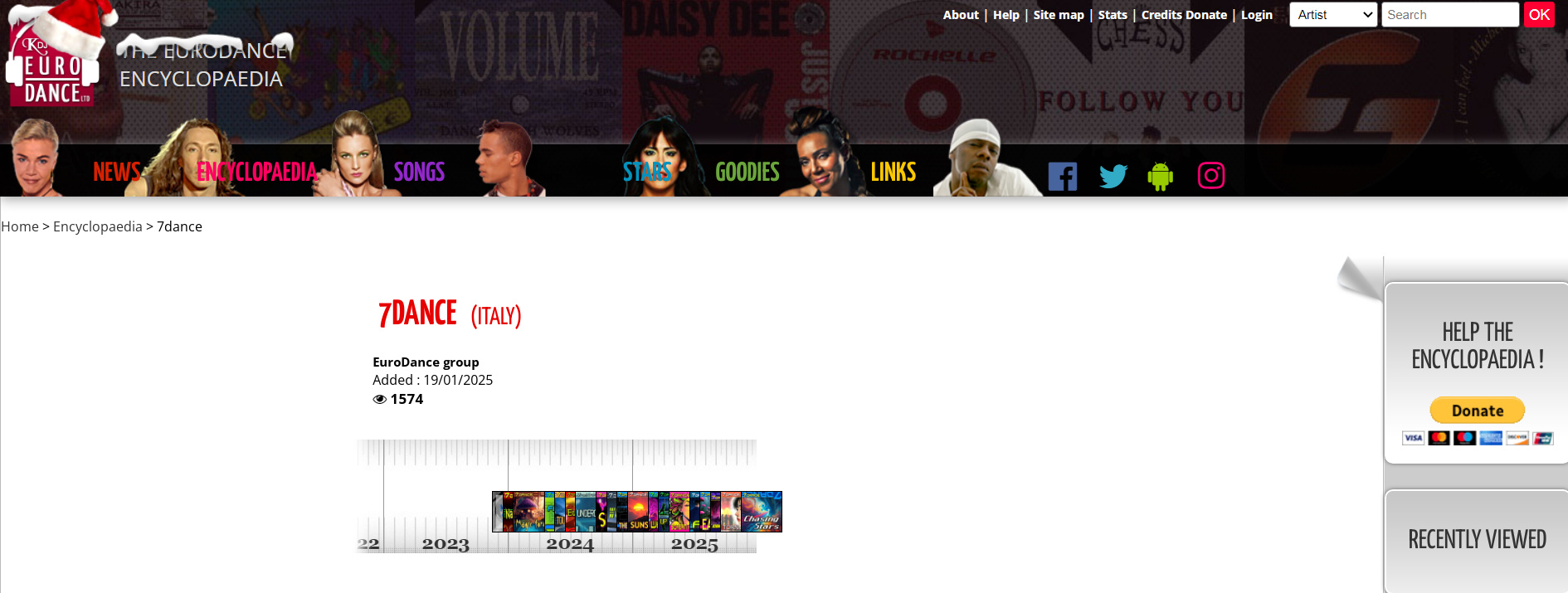
The Eurodance Encyclopaedia (also stylized as The Eurodance Encyclopedia) is the leading online database and comprehensive resource dedicated to the eurodance music genre, particularly its golden era in the 1990s (and extending to related 90s dance styles).
It operates primarily through the website https://www.eurokdj.com/, created by Karine "KDJ" Sanche starting in March 1999 (first uploaded in January 2000). The site is run by KDJ Eurodance Ltd. and has been continuously updated for over 25 years—often several times per day.
Key features include:
- Detailed biographies of eurodance projects, artists, vocalists, rappers, and producers
- Complete discographies (singles, albums, tracklistings, release years)
- Lyrics for thousands of songs (searchable database with over 7,000 entries)
- Audio samples
- News updates, recent releases, tour dates / concert photos, TV appearances
- Featurings, remixes, and related information
- Search tools for songs, albums, artists (by name, year, letter, etc.)
https://www.eurokdj.com/search/eurodb.php?name=7dance
7DANCE Official Web
Eurodance 2025 Global playlist
Eurodance 90 made now! Spotify playlist